general information
5G is the next generation of wireless network technology that is expected to change the way people live and work. Compared to the current 4G LTE network, it will be faster and can support more connected devices. These advances will pave the way for many new technology items. Although 5G networks are still in their infancy and have only just started rolling out in the United States and elsewhere in 2018, experts believe they have enormous potential. With the help of this technology, it is possible to manage growing user base and increasing demand for bandwidth. 5G availability and coverage is also limited, but carriers have installed networks in key cities. because so many people want to take advantage of 5g today. Intel then offers four Intel 5G technologies, from workload-optimized network servers to edge devices, to realize the full potential of 5G. Because of how mobile the world is today and how much data we use annually, especially with the rise in popularity of streaming music and video, 5G is desperately needed. When several users in one location attempt to use online cellular services concurrently, existing spectrum bands become congested, disrupting service.
technical information
5G is the fifth generation of mobile internet connectivity that promises much faster data download and upload speeds. It is currently planned to operate on the high-frequency bands of the wireless spectrum between 30GHz to 300GHz, which are called the millimeter wave spectrum. These waves can transfer data at very high speeds, but they are difficult to pass through walls, buildings and other obstacles. Companies like Qualcomm and Intel are experimenting with using the sub-6 GHz range to augment the wave signal with something more stable. The focus of 5G development is to increase broadband, mission-critical services, and massive IOT connectivity.
Historical information
The first generation of mobile networks (or 1G) was launched by Nippon Telegraph and Telephone (NTT) in Tokyo in 1979. By 1984, NTT had rolled out 1G to cover the whole of Japan. In 1983, the US approved the first 1G operations and the Motorola DynaTAC became one of the first’mobile’ phones to see widespread use. However, 1G technology suffered from poor coverage, sound quality, no roaming support, compatibility between systems, and calls being unencrypted. Despite these shortcomings and a hefty price tag, the DynaTAC still managed to rack up 20 millionglobal subscribers by 1990. This success paved the way for the second generation, appropriately called 2G.
The second generation of mobile networks, or 2G, was launched in Finland in 1991. It enabled calls to be encrypted and digital voice calls to be clearer. It also allowed people to send text messages, picture messages, and multimedia messages on their phones, leading to mass-adoption by consumers and businesses. Transfer speeds were initially 9.6 kbit/s, but by the end of the era, speeds of 40 kbit/s and EDGE connections offered speeds of up to 500 kbit/s. 2G revolutionized the business landscape and changed the world forever.
3G was launched by NTT DoCoMo in 2001 to standardize the network protocol used by vendors. This enabled users to access data from any location in the world, leading to the rise of new services such as video conferencing, video streaming and voice over IP. In 2002, the Blackberry was launched, and in 2007, the iPhone was launched, extending 3G’s network capability.
4G was first deployed in Stockholm, Sweden and Oslo, Norway in 2009 as the Long Term Evolution (LTE) 4G standard. It was subsequently introduced throughout the world and made high-quality video streaming a reality for millions of consumers. However, device manufacturers needed to be specifically designed to support 4G, leading to Apple’s rise to become the world’s first trillion-dollar company. Some regions are plagued by network patchiness and have low 4G LTE penetration, such as the UK, where only 53 percent of the time can access 4G networks.
Kevin Ashton coined the term “the Internet of Things” (IoT) in the 1990s to convince Procter & Gamble to start using RFID tag technology. By the early 2000s, developers knew that 3G and even 4G networks wouldn’t be able to support such a network. In 2008, NASA helped launch the Machine-to-Machine Intelligence (M2Mi) Corp to develop IoT and M2M technology, as well as the 5G technology needed to support it. In 2012, South Korea developed a 5G R&D program, while New York University founded the 5G-focused NYU WIRELESS in 2012. Three South Korean carriers – KT, LG Uplus and SK Telecom – rolled out live commercial 5G services last December and promised a simultaneous March 2019 launch of 5G across the country.
Impact of Technology
• Increased Connectivity: 5G technology is expected to provide faster and more reliable internet connectivity, allowing more devices to connect to the internet and enabling new technologies and applications at lower latency (less than 10 ms).
• Improved Communication: 5G is expected to enable faster and more efficient communication, both between people and between machines. This could lead to better collaboration and coordination, both within organizations and among individuals.
Enhanced Experiences: 5G is expected to enable new and enhanced experiences in areas such as virtual and augmented reality, gaming and video streaming.
• Increased Productivity: 5G is expected to enable new ways of working and doing business, such as remote collaboration and automation, which could increase productivity and efficiency.
Future Advancements AND/OR Future Applications of the Technology
Five Advancements 5G Will enable in the Future
5 Things:
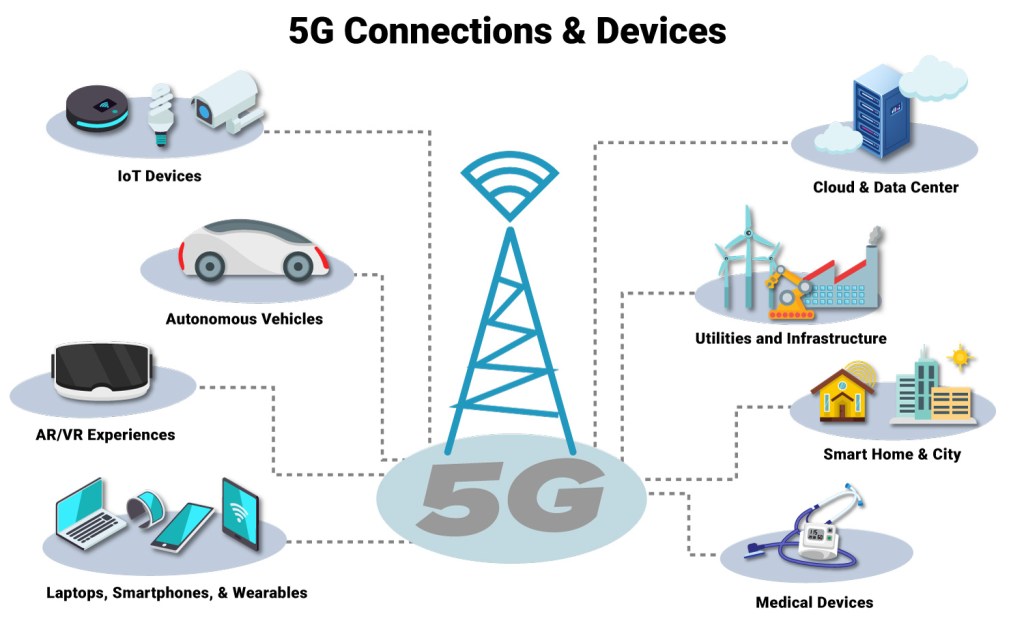
- 5G, AI and IoT are essential components of Industry 4.0, as they will enable smart factories to use robots powered by AI and machine learning to make real-time decisions, while also providing augmented reality and virtual reality training experiences, allowing employees to learn faster and safer. This is why the manufacturing industry is investing in IOT investments, and it is expected to do so through 2020
- AR and VR are transitioning to virtual reality and augmented reality, allowing for real-world applications such as Pokemon Go. Microsoft’s HoloLens2 will bring physical and digital elements together to collaborate in real time, and mixed reality will explode with real world applications. 5G will get the credit, and AR and VR will become part of everyday life.)
- (5G is the technology that finally pushes autonomous machines out into the world, as it is the only technology fast enough to allow machines to mimic human reflexes. It’s the only thing reliable enough to rest a human life on, and it won’t roll out overnight. Once it is available everywhere, there will be no stopping the development of safe autonomous machines.).
- (The most important idea is that 5G is the only technology fast enough to allow for the development of connected technologies, such as trash pickup, public restrooms, and electric power outages, which can help cities improve their infrastructure.).
- (Edge computing, also referred to as fog computing, enables data to be analysed as close to the path as possible, improving the safety of devices like driverless automobiles. The cloud, however, is not trustworthy enough to store all of the data that the IoT will produce. The potential of edge computing will be realised in a wide range of applications, from Smart Cities and Factories to retail environments for real-time offers and analytics, with the high speed, low latency data transfer of 5G.)

references:
Balmuri, K.R., Konda, S., Lai, W.-C., Divakarachari, P.B., Gowda, K.M.V. and Kivudujogappa Lingappa, H. (2022). A Long Short-Term Memory Network-Based Radio Resource Management for 5G Network. Future Internet, 14(6), p.184. doi:https://doi.org/10.3390/fi14060184.
Cisco (2019). What is 5G? [online] Cisco. Available at: https://www.cisco.com/c/en/us/solutions/what-is-5g.html [Accessed 2 May 2023].
Dolgui, A. and Ivanov, D. (2021). 5G in digital supply chain and operations management: fostering flexibility, end-to-end connectivity and real-time visibility through internet-of-everything. International Journal of Production Research, 60(2), pp.1–10. doi:https://doi.org/10.1080/00207543.2021.2002969.
expert, I. (2021). 5G and Enhanced Connectivity – The ICT Trends. [online] The ICT Trends – The ICT Trends LLP. Available at: https://theicttrends.com/5g-and-enhanced-connectivity/ [Accessed 1 May 2023].
Intel (2020). 5G Features and Benefits. [online] Intel. Available at: https://www.intel.com/content/www/us/en/wireless-network/5g-benefits-features.html [Accessed 2 May 2023].
Moore, M. (2019). 5G and smart cities: everything you need to know. [online] TechRadar. Available at: https://www.techradar.com/news/5g-and-smart-cities-everything-you-need-to-know [Accessed 2 May 2023].
Nam, S. (2022). The impact of 5G multi‐access edge computing cooperation announcement on the telecom operators’ firm value. ETRI Journal, 44(4), pp.588–598. doi:https://doi.org/10.4218/etrij.2021-0185.
Newman, D. (2019). Five Advancements 5G Will Enable In The Future. [online] Forbes. Available at: https://www.forbes.com/sites/danielnewman/2019/03/06/5-advancements-5g-will-enable-in-the-future/?sh=2cdd55c30933 [Accessed 1 May 2023].
 defa
defa 